Showing posts with label exhibition. Show all posts

Tuesday, 28 January 2014

Image-Text-Object: Practices of Research

An exhibition of doctoral research projects from 
Winchester School of Art
Level 4 Gallery, Hartley Library, University of Southampton.
10th February - 16th March 2014


This exhibition presents a series of images, texts and objects, which lead us to think about different ways of seeing, thinking, writing and making. The works on display derive from a range of research projects at Winchester School of Art, University of Southampton. The School is dedicated to the exploration of diverse practices and creative research methods. Studio-based researchers in art and design work alongside those engaged in humanities and social science research, covering areas of art history, critical theory and curatorial practice, as well as the management and marketing of design, media, fashion, and textiles. All researchers at the School are engaged in the critical making of new knowledge: each moving in and out of complex and disciplined modes of activity. Whether it is reading, writing, looking, making, coding, speaking, recording, and much else besides, each are forms of imaginative and critical engagement, developed and extended within the context of a collaborative and inter-disciplinary research community.

Works shown by:
Richard Acquaye, Bedour Aldakhil, Hazel Atashroo & Oliver Peterson Gilbert, Najla Binhalail, Jane Birkin, Rima Chahrour, Ian Dawson, Kate Hawkins, Ben Jenkins, Sunil Manghani, Kay May, Nina Pancheva-Kirkova, Nicky Athina Polymeri, Walter van Rijn, Elham Soleimani, Lisa Temple-Cox, and Simiao Wang.

Practice [ˈpraktɪs] trans. To test experimentally, to put to the test; n. the actual application or use of an idea, belief, or method, as opposed to theories relating to it; v. to perform an activity or exercise a skill repeatedly or regularly in order to acquire, improve or maintain proficiency. ORIGIN late Middle English to mean ‘a way of doing something, method; practice, custom, usage’; also ‘an applied science’ (late 14th Century); similarly from the Old French of practique to mean ‘practice, usage’ (13th Century) and directly from the Medieval Latin practica, meaning ‘practice, practical knowledge’; with the underlying root from the Greek praktike to mean ‘practical’ as opposed to ‘theoretical’. Yet, equally, practice encompasses understanding, relating, for example, to the knowledge of the practical aspect of something, or practical experience, which arguably underpins all forms of enquiry, research and the creation of new knowledge.

“In everyday language we refer to practice as the application or use of an idea, belief or method. For example, we can speak of the principles and practice of teaching. It also means exercising a profession. The lawyer practices law, the doctor practices medicine. We’re familiar with the idea of business practices, which may differ across sectors of an economy and alter over time. Practice can also refer to the premises of a business, such as the doctor or solicitor’s practice. Perhaps most frequently, however, we refer to practice as the repeated exercise of an activity or skill so as to acquire proficiency in it; a child practices a musical instrument and if they complain we gently remind them: ‘Practice makes perfect!’ Practice, then, can mean a customary, habitual, or expected way of doing of something: a technique or set of techniques that end in a particular result (as Aristotle claims for praxis). In the university setting, the practice of a subject, such as law, medicine, art or music, refers not simply to attaining of a certain degree of proficiency, but to becoming situated and expert within a field of study. Furthermore, practice in this sense can refer to speculative endeavours, which allow unexpected outcomes and help challenge established ways of thinking, thus making it both repetition and variations based on and in response to repetition required to hone a skill. The artist’s studio, for example, is a site of sustained practice in making and re-making images and objects of culture. The writer, as a practitioner of words, works and re-works texts in pursuit of new thoughts, images and meaning; while the ethnographer, as participant observer, reports on the knowledge and the system of meanings in the lives of a cultural group, which otherwise remain unarticulated.

As a set of interacting centrifugal and centripetal forces, research practices – simultaneously and paradoxically – take us toward and away from disciplined ways of understanding and fashioning the world we inhabit. We look, ponder, write and make; always prompting practical forms, engagements, and processes. To decouple the misconstrued, yet persistent divide of practice/theory, we might usefully pair the Greek praktike not with a single term for theory, but two philosophical terms: theoria (contemplation) and theoros (participation), the latter emphasizing an act of witness and participation in an event or activity. Together these terms help us consider a more fluid notion of theory and practice, whereby the two become inextricably intertwined and one impossible without the other. In experiencing an artwork, for example, theoria helps conceptualise the interface between art and its viewer. The artwork does not possess an intrinsic ‘truth’ claim, but does have a claim upon us – at its simplest, the artwork demands it be considered an artwork, to which the viewer must respond, even if the response is to deny it such status. The artwork, then, places us immediately into both a practice of thinking and a thinking of practice.”
Sunil Manghani 2014

Private View 13th February 5pm – 7.30pm


As I have only recently begun this programme of practice-based research, I will be showing an installation combined of elements created during and after my MA, provisionally titled 'An Order of Things: False Membranes'.

"There is a symbolic order within the conceptual architecture of a space that exists, in potentia, in both clinic and altar. What is the relationship between these systems? Both have relevance to our exploration of self, during which we invariably encounter something primal, unconscious, alongside the scientific – here represented by the supposedly objective medical gaze. We use art in our search for self, and art uses media that not only signify the body – flesh, blood, faeces -­ but invoke a sense of the abject: a separation of subject from object, a rejection of death. The aesthetic of the medical museum and its exhibits may have similar psychological effects on its visitors, containing specimens that simultaneously attract and repulse. In the casting of the face the eyes of necessity remain closed, thus blurring the distinction between life mask and death mask, in much the same way that the preserving fluid and curve of the glass jar further distorts the teratological specimen.
Our relationship with our bodies and selves is reflected in the mirror of the operating theatre. The theatre of medicine becomes the stage: the speculum becomes spectacle, the looking-glass of self turned outward. The work shown is a visual exploration not only of the way in which the museum specimen can seem to reflect, in some measure, residues of the human, but return the gaze of the spectator to create a deeper reflection of self: from object to abject, self to other, and back. Here, the artist becomes both subject and object. The eyeless faces, made diseased and necrotic by the rough textures of the materials, serve to connect the contemporary concerns of anatomy with an unconscious atavism – a simultaneity of the pure and the profane. There is a realm of sympathetic magic in the territory between form and misform: somewhere in these anachronistic juxtapositions of scientific paraphernalia and animistic object, the clinic and alter may be revealed to be synonymous." 


Friday, 7 June 2013

Lovely Bones: ‘inappropriate’art and animal remains

I was recently asked to show some work at a University in the north of England, by an academic I'd met at a conference on anatomical collection. He’d seen my presentation “Making myself a Monster”, which I’ve posted in its entirety earlier in this blog, and wanted me to show work to his History of Medicine students that would challenge and stimulate them to think differently about the body and its forms of representation. I duly set off with a number of pieces, which ranged from drawings of anatomical specimens to boxed assemblages and life masks.

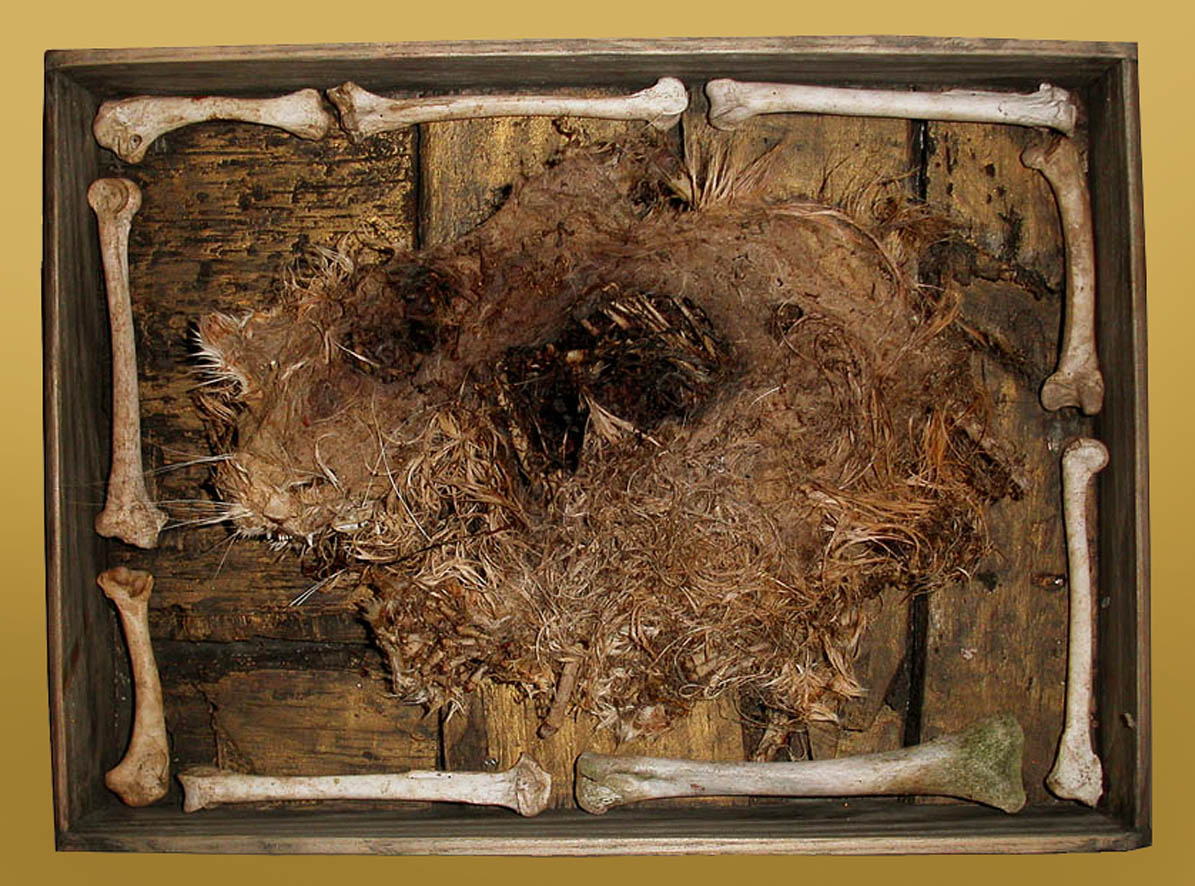
Within an hour of hanging – and before, in fact, many of the pieces had gone up – I had a call saying that the head of the school had decided that the majority of the work was 'inappropriate', and requesting that it be removed. A number of pieces that were rejected featured drawings of teratological specimens, and in that case I can understand their concern – the venue is in close proximity to Alder Hey, and the echoes of that scandal continue to be felt in the public conscious. However most of the work deemed 'inappropriate' was not human anatomy, but contained, among other ephemera, specimens or drawings of dead animals. The content of these artworks ranged from an entire animal (cat, mouse, bird) to some with small bones in amongst the other found objects that I use in assemblages.

Why should some people - who happily eat meat, wear leather or fur, and set traps for mice - object to being confronted with animal remains on display in a gallery? Why is the notion of animal framed and re-contextualised as art so much more disturbing than the chewing and digesting of them, wearing them, shooting them for sport, or killing them as pests?  There is a disturbing dualism at play here; sentimentality at odds with a brutal indifference. Furthermore, there is the sense that their own dislike of the work has had to be re-framed as a moral issue, with the offended parties casting themselves as gatekeepers of propriety: deciding what is best, on behalf of others who will then have no opportunity to see the work that they are being saved from. As Steve Baker says in his book ‘Artist/Animal’,
“…accusations of offensiveness lump together aesthetic distaste and moral outrage, as they often do in public responses to contemporary animal art…” 

So why do I work with animal remains? This is not something I've ever asked myself - or indeed been asked. If I had to make a statement of some kind, I would say that I find something beautiful and compelling in the bones and skins of formerly living creatures - the static remnants, preserved by nature, decayed, decomposed and dried, so redolent of their former life but transformed by death into something else. I don't kill things, but pick them up as I find them. Sometimes, if the little corpses are still too fresh to keep, I bury them in my allotment and use the bones after the earth has done its work. 


I am not alone in seeing beauty in decay. 

The problem I have with working with remains is not the fact of their provenance, but that, while beautiful, they are very powerful objects, containing so much emotional resonance in relation to the awareness of mortality. Bones are hard to work with. Bones are bones, skulls are skulls, and their effect as representations of death makes them such striking objects in their own right that using them as art materials creates difficulties in the same way as working with text; decorative and beautiful, but difficult to divorce from its meaning - difficult not to read. People read the language of bones in very specific ways.


I take several approaches to this problem: one is simply to present the animal remains as I found them, laid out and boxed whole, a record of the transience of life and the structure of remains. Another is to reconstruct them into other, still beautiful, objects: wearable objects, such as fascinators, or rearranged into new work, to use the bones and fur and skin as materials in the same way as I would use other found objects such as buttons, paper ephemera, shells, or broken watches. The symbolism of the Vanitas pervades all this work, so perhaps in essence I'm not really changing the narrative of the remains. Other artists have worked with remains more directly: painting or drawing on them, covering them with other materials. I have been experimenting with painting or drawing the remains, and using this work - a step removed from the original material - in the boxes instead. Or covering them with gold leaf, or fur from a different animal, or paper - text or music notation - to force a shift in appearance, and therefore meaning.  


In which case, why use animal remains at all? Why not casts, or papier-maché, or something else entirely? I suppose there is something intrinsically 'authentic' about the remains – their organic nature, a reference to death and change – perhaps it all just comes back to the Vanitas, a reminder of our mortality which is often hidden or disguised in contemporary life. A group of my teenaged art students were horrified by my recent description of 'Hello Kitty' (the first work to go from this exhibition).They asked if I had an obsession with death. I said no, merely an acceptance of the fact that I was going to die, as all living things must. When I added that they too were going to die, one girl said she was going to tell her mum. I pointed out that her mother was going to die as well...


I suspect my career as a teacher will be as short as my exhibition – but that is in itself a reflection of the way that death is denied in current culture: the 'disneyfication' of the reality that life is, oftentimes, short and brutal and remarkably lacking in talking cats and rainbow coloured horses.


    None of this really explains why I like to use this material. But I'm not certain, in the end, that I really need to. The work speaks its own language, at a visceral level, to those who not too hampered by their conservatism to read it.

Tuesday, 2 April 2013

Foreign Bodies


This blog post and train of thought was inspired, indirectly, by the current exhibition at UCL and related venues entitled 'Foreign Bodies'. Curated by students at UCL, and using specimens from that collection, it is at once a display of unusual objects, and an opportunity to consider things simultaneously anatomical, historical, scientific and sociological.

My exploration of this exhibition began by my entering the University through the wrong door, and seeing the second part of the linked series of displays first. I found myself in the UCL Art Gallery, where I came upon a selection of the Galton collection of life and death masks.
Having previously seen these in a storage room at UCL, where many were charmingly stored with paper hats on their heads to keep the dust off, it was interesting to observe them on display. The documentation that used to accompany them has been lost, so - alongside the fact that many from this collection are missing - there is nothing to tell you who the subjects once were, or even if they were alive or dead when the mould was made. There are some tell-tale signs - a tension between the eyes in the living subjects, a disconcerting laxness about the mouths of others, a disturbing disjunction in the necks of those that may have been hanged - and some anecdotal reference, such as that relating to the death mask of a boy - a child musical prodigy who died very young.

 Part of what I found alluring was the fact that they have become so dirty. A lack of funding for the kind of cleaning they might require has resulted in a visual illusion of negativity: the creases are clean and white, the surfaces of the skin grey and grimy. This seemed like a metaphor for their state; a reversal of tone, reflecting their uncanny position between the actual and the representation.

Most interesting, perhaps, was the conversation I ended up having with the young woman behind the desk, of whom I inquired if I was, in fact, in the right place. We talked for quite a while - about the death masks, and other anatomical objects: about states of being, the moral and ethical effects on surgeons of cutting into the body (a form of trangression that might cause shockwaves in the emotional states in which they, quite literally, operate). About the possible reasons why Jeremy Bentham's death mask might be in Norwich Castle (his body, famously, residing just down the corridor from where we stood). About mapping, and identity, and being an outsider - being in-between, on many levels. It transpired that we had met some years previously, when she organised a symposium on facial recognition that I had attended when I first began my MA and my current body of work, and this led to another conversation about recognition, identity, and chance encounters.

It was very interesting to discuss this idea of being outsider, or in-between states and places. I think more and more that the mapping project I am currently engaged in is very much a search for identity and self, using the anatomical museum, its contents and location, as a metaphor. I am still struggling with writing this in a way that makes sense. The hardest thing is to articulate what the expected outcomes will be - why am I interested in the subjects and objects of these anatomical collections, and what do I hope to discover?

Still, that is all part of the process. And it is interesting to consider that a sense of being an outsider is an advantage which others might not have - this is something else that we spoke of, and I think that might be true - the additional ability to emphasise with others who are in-between, and to see patterns which those who are comfortably embedded in their lives or cultures might not.

I realised during this conversation that this synchronous meeting could perhaps have been the real purpose for my visit.  I am more convinced than ever that sometimes the delays, frustrations, and stumbling blocks that we perceive as being put in our paths - or that we put there ourselves - must be for a reason, to do with our individual approaches to actualising the life changes we desire to make.  The notion that the path we think we are on is not the same as the one we are, in fact, following, might be the underlying reason that I went to see this exhibition, and why - most tellingly - I came in through the wrong door..


for more information on the exhibition and related subjects visit these blogs: